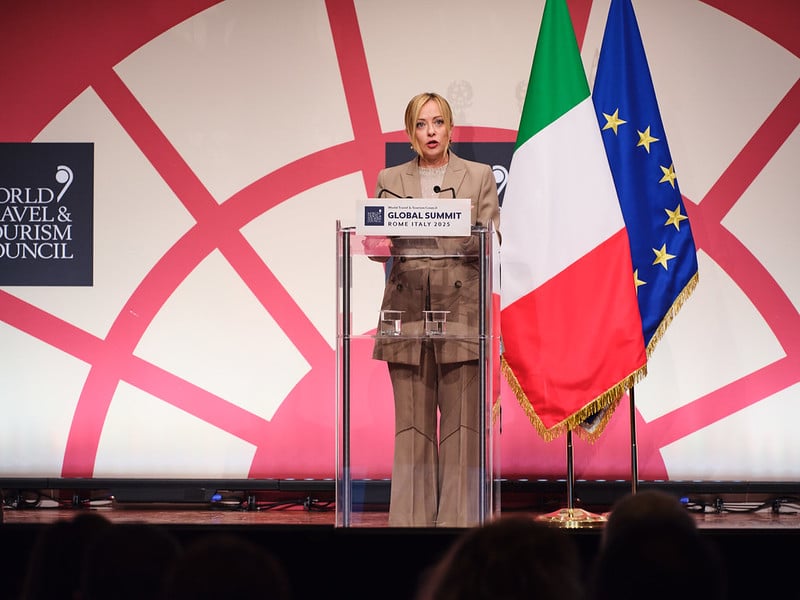
The World Travel & Tourism Council Global Summit in Rome this fall was an event to behold, a gathering of the world’s movers and shakers in travel with a decidedly Italian focus as this is the first time Italy has hosted the event. The WTTC is a global organization that represents the private sector travel and tourism industry, working with governments and international bodies to raise awareness of the economic and social importance of tourism. From the start the focus was clear: this was Italy’s moment to demonstrate leadership in global tourism.
Italian Prime Minister Giorgia Meloni (pictured below) opened the summit at Rome’s Auditorium Parco della Musica with a detailed address that positioned tourism as both an economic driver and a pillar of national identity. She reminded delegates that the sector now accounts for 13% of Italy’s GDP, supported by reforms such as tax-free tips, investment in staff housing, and new legislation against fake online reviews.
Meloni also announced that Italy ranks fifth globally with 58 million international arrivals, adding “These numbers make us proud of the work we have done, but they are still not enough. Because we are Italians, and being content is not in our DNA.”
Her message was followed by a data-driven handover speech from outgoing WTTC Chair Greg O’Hara, who reported that global investment in travel and tourism is projected to reach $1.15 trillion in 2025, with travelers expected to spend a record $2.1 trillion internationally. “Capital only flows where it sees a future,” he said. “And right now, investors are seeing that future in our sector.”
O’Hara’s final act as chair was to introduce Manfredi Lefebvre d’Ovidio, the Roman-born travel icon succeeding him. Lefebvre, Executive Chairman of Heritage Group and Abercrombie & Kent Travel Group, is a veteran of the luxury travel industry, best known for transforming Silversea Cruises into a global leader before selling it to Royal Caribbean.
In his first address as WTTC Chair, Lefebvre emphasized travel’s human dimension. “I started in this sector at nineteen, working for a cruise line” he said. “Travel and tourism are made by people, for people. They change lives, creates jobs, and uplifts communities.”
After Prime Minister Giorgia Meloni and outgoing Chair Greg O’Hara set the stage with their speeches, I had the chance to sit down with Lefebvre at the Grand Hotel Minerva, one of Rome’s newest luxury properties.
When I asked him whether it truly felt like Italy’s moment, he answered without hesitation. “This is one of the first Italian governments to focus seriously on travel and tourism,” he told me. “After the pandemic, an entire part of our economy was frozen. This government understands the importance of private enterprise, family businesses, and what we call Italianità: our art, culture, food, and nature. It’s proud of being Italian, and that pride aligns with what WTTC stands for.”
When I enquired about what it meant specifically for the summit to take place in his hometown, Lefebvre beamed, “I pushed everything I could to make it happen here,” he said. “The government did an extraordinary job, our members came in numbers, and the turnout exceeded expectations.”
Our conversation turned naturally to cruising, a business Lefebvre knows intimately. “Cruising is vacation while traveling,” he explained. “Experiential travel, like Abercrombie & Kent, is discovery while moving. They attract the same type of person, curious travelers who want comfort, safety, and exploration all at once.”
Safety, he added, has become one of the defining themes in post-pandemic travel. “The world is full of uncertainties. People want to travel, but they also want to feel protected. That’s part of well-being now.”
The industry’s collaborative spirit was captured in one of my favorite sessions of the summit, when Lefebvre appeared on stage with Torstein Hagen, founder of Viking Cruises. The two shared a story that summed up the friendly rivalry between their companies: every Viking ship features an Italian restaurant named Manfredi’s, while on Silversea vessels, the libraries are named “Tor” after Hagen. (I’ve actually eaten at Manfredi’s on Viking and had a delicious, authentically Italian meal!)
Lefebvre’s approach to his new WTTC role appears pragmatic. “Governments need to understand us better,” he said. “Legislation should support travel, not discourage it. Within WTTC, I want stronger interaction with our members, not just their names or funding, but their ideas and talent. We’ll strengthen communication and build systems that keep the organization close to its members.”
He described this agenda as a long-term effort. “I started my first working meeting today at four o’clock,” he said with a smile. “The world wasn’t created in seconds, it took seven days. We’ll take our time, but we’ll get there.”
Across the summit, themes of innovation and resilience echoed through the sessions. WTTC CEO Gloria Guevara praised Italy’s leadership, calling it “a place where culture, heritage, and La Grande Bellezza converge.” She noted that visitor spending in Italy is expected to reach €60 billion this year, more than one billion euros a week, and credited Meloni’s administration for making tourism a national priority.
The event also celebrated Europe’s continued dominance as the world’s largest tourism region. Between high-level discussions on investment, AI, and sustainability, the summit featured cultural moments, including a special performance by Andrea Bocelli, and underscored how travel has rebounded not just as an industry, but as a force for global connection.
As Lefebvre begins his tenure, his focus is clear: fostering collaboration between governments, businesses, and travelers. “Our job,” he said, “is to make sure this sector keeps growing, but also keeps meaning something for the people who work in it and for those who explore through it.”
The atmosphere in Rome was notably business-oriented, less about celebration, more about execution. Italy, for its part, used the summit to confirm its strategy: attract high-quality visitors, extend the season, and diversify destinations. With upcoming global events like the 2026 Winter Olympics in Milan-Cortina and the 2032 European Football Championships, the momentum is significant.
By the summit’s end, the consensus was clear: Italy has reclaimed its leadership role in global tourism. The numbers are improving, investment is rising, and policy alignment between public and private sectors is stronger than it has been in decades.
As Lefebvre put it, “This is Italy’s moment. Now the task is to make it last.” — Kathy McCabe
Trending Products


Tec Italy Lumina Shampoo & Cond...